
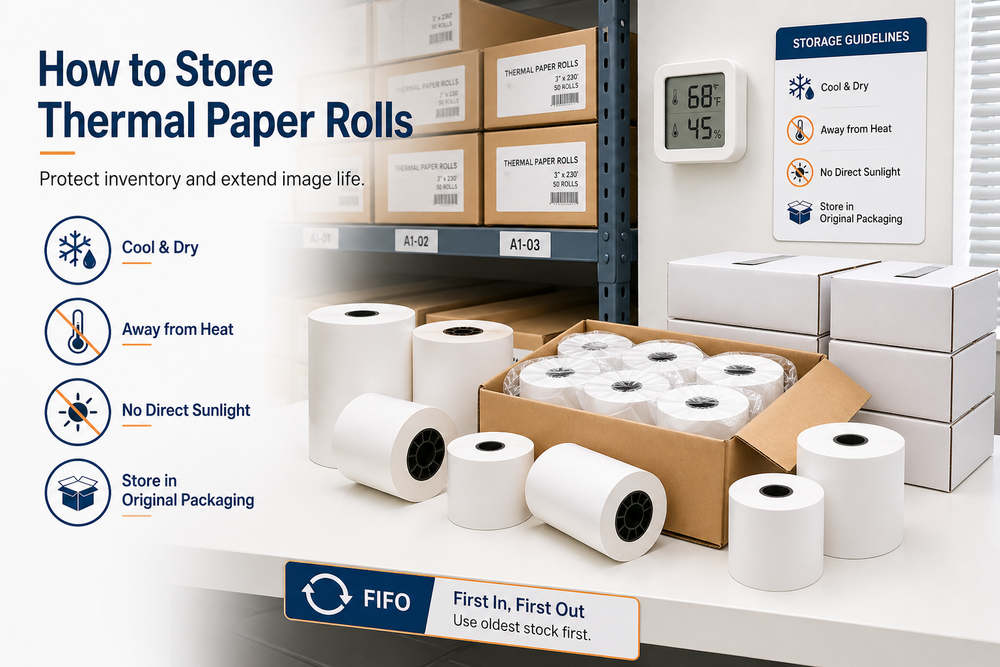
How to Store Thermal paper Rolls
Mar 26th 2026
How to Store Thermal Paper Rolls:
Protect Your Inventory and Extend Image Life
Thermal paper is more sensitive than it looks. Heat, UV light, humidity, and certain chemicals can ruin a roll before it ever reaches your printer — and degrade printed receipts long before they need to be readable. Here is exactly how to store thermal paper correctly at every stage from receiving to register.
Why Thermal Paper Is Sensitive
Thermal paper produces images through a chemical reaction — the heat-sensitive coating darkens when exposed to heat from a printhead. The problem is that the same coating reacts to any heat source, not just your printer. It also reacts to UV light, certain plasticizers (found in rubber bands and some plastic bags), and solvents including hand sanitizer and cleaning products.
A roll stored incorrectly can pre-react before it is even loaded — producing dark paper, faded prints, or no image at all. For inventory you've paid for and are relying on during a busy service, that is an expensive and avoidable failure.
The #1 storage mistake: Leaving thermal paper rolls in a delivery vehicle, storage room, or back-of-house area near a heat source. Summer temperatures inside a parked delivery vehicle can exceed 150°F — hot enough to pre-react an entire case of paper before it reaches your register.
Ideal Storage Conditions
Do's and Don'ts
✓ Do
- Store in original manufacturer packaging until ready to use
- Keep in a cool, dry, climate-controlled storage area
- Store rolls horizontally to maintain round shape
- Use a FIFO (first in, first out) rotation — older stock to the front
- Store away from solvents, cleaning products, and hand sanitizer
- Keep sealed until the roll is needed at the register
- Store bond and thermal paper separately to avoid mix-ups
✗ Don't
- Store near heat sources — ovens, fryers, HVAC vents, hot water pipes
- Leave cases in delivery vehicles, especially in summer
- Store near windows with direct sunlight
- Wrap rolls with rubber bands — plasticizers cause coating to react
- Store in plastic bags long-term — can trap moisture and heat
- Store near cleaning chemicals, degreasers, or hand sanitizer dispensers
- Place heavy objects on top of rolls — flattens core and causes jams
Shelf Life by Paper Type
| Paper Type | Unopened Shelf Life | Printed Image Life | Notes |
|---|---|---|---|
| Standard Thermal | Up to 18–24 months | 5–7 years | Stored properly in original packaging |
| BPA-Free Thermal | Up to 18–24 months | 5–7 years | Same storage requirements as standard |
| Phenol-Free Thermal | Up to 24 months | 10–25+ years | Superior image stability — ideal for records that must remain legible long-term |
| Outdoor-Rated / Pump Paper | Up to 24 months | 2–5 years exposed outdoors | UV stabilized — still requires indoor storage before use |
| Bond / Carbonless | 2–5 years | Long-term if kept from moisture | Less sensitive than thermal — avoid humidity |
| ATM Paper (Inside-Wound) | Up to 24 months | 7–10 years | Store upright or horizontal — protect 1" core from crushing |
Not sure whether Phenol-Free is right for your operation? See our Phenol-Free vs BPA-Free guide for a full breakdown.
Special Situations
How to Tell If Your Paper Has Been Damaged
Before loading a roll, do a quick visual check:
Signs of heat or UV damage: The outer layer of the roll is noticeably darker than the inner layers. The paper feels brittle or has a gray tint. Prints come out faint or uneven even with a clean printhead. The roll edge shows browning or yellowing.
If you suspect damage, do the fingernail scratch test on a new section of paper closer to the core. If it marks dark, the paper's thermal coating is still reactive — the outer layers may be salvageable by removing a few turns. If the paper does not react to the scratch at all, the chemical coating has been exhausted and the roll should be replaced.
Call us — we'll help you spec the right paper and quantity for your storage setup. B2B pricing available.